

On this page
Introduction to the 2026 UAE Salary Landscape
Navigating the New Economic Normal
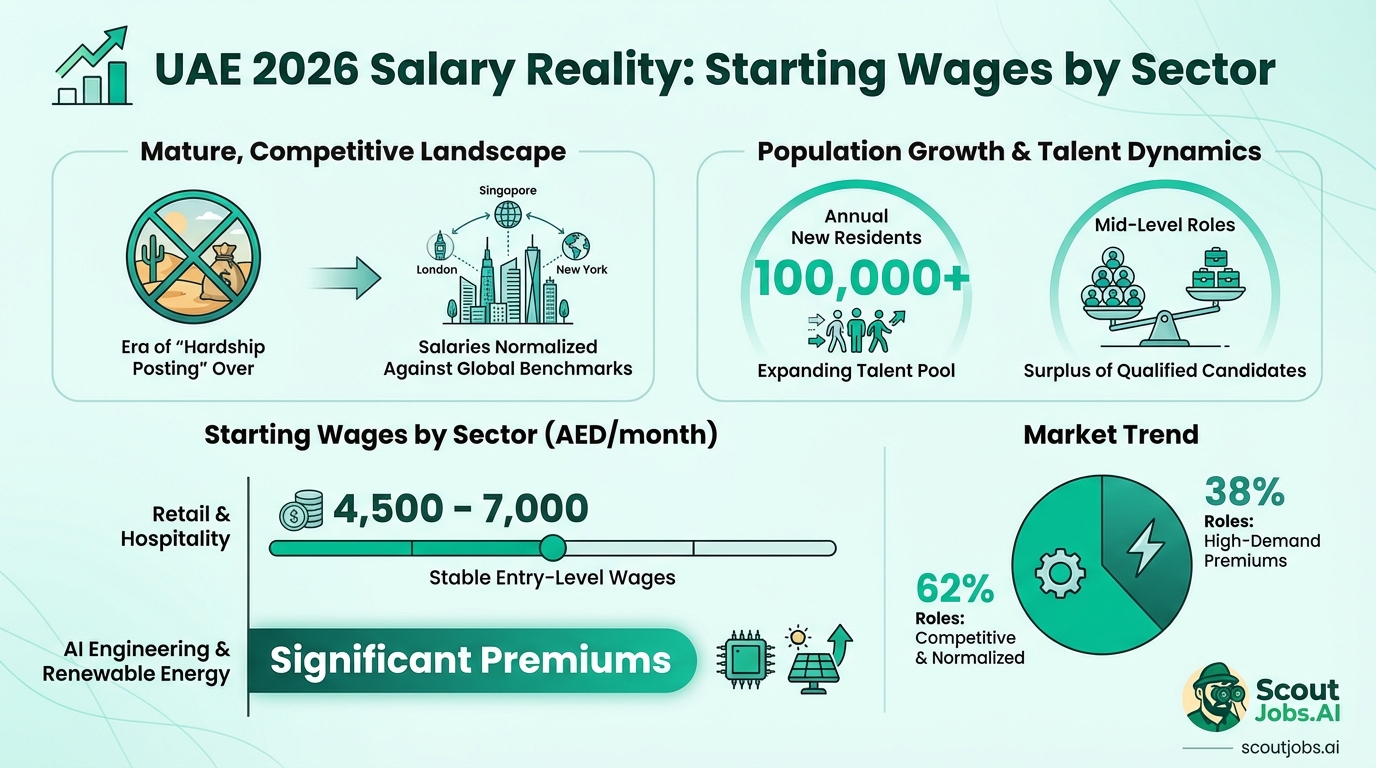
As we enter 2026, the UAE’s labor market has undergone a fundamental transformation. The era of the "hardship posting"—where expatriates received massive tax-free premiums simply for relocating to the Gulf—is largely over. In its place, we find a mature, highly competitive landscape where salaries have normalized against global benchmarks in London, Singapore, and New York. This shift is driven by the UAE’s status as a top-tier global destination, attracting over 100,000 new residents annually to hubs like Dubai and Abu Dhabi.
Population Growth and Talent Dynamics
The rapid population surge has significantly expanded the talent pool, creating a surplus of qualified candidates for mid-level roles. Consequently, while entry-level wages in sectors like retail and hospitality remain stable around AED 4,500 to AED 7,000, high-demand niches like AI engineering and renewable energy continue to command significant premiums. Recent data suggests that while 62% of UAE firms plan to increase headcount this year, the focus has shifted from volume hiring to specialized expertise. According to insights from Robert Half, the depth of the talent pool is allowing employers to stabilize wage growth in generalist roles.
What This Guide Covers
This comprehensive 2026 reality check provides a data-driven look at what job seekers can actually expect to earn. We will explore:
- Sector-Specific Ranges: From Fintech in DIFC to Logistics in JAFZA.
- The Experience Premium: How years of local UAE experience impact your bargaining power.
- Benefits Beyond Salary: The rising importance of flexible work and health-focused packages.
| Sector | Volume of Active Listings (ScoutJobs AI) | Entry-Level Demand Level |
|---|---|---|
| Information Technology | 709 | Critical |
| Engineering & Architecture | 668 | High |
| Tourism & Hospitality | 489 | Very High |
For employers, this guide offers a benchmark to ensure competitive offers in a market where talent is mobile but increasingly discerning.
The MoHRE 2026 Minimum Wage Mandate
The MoHRE 2026 Minimum Wage Mandate
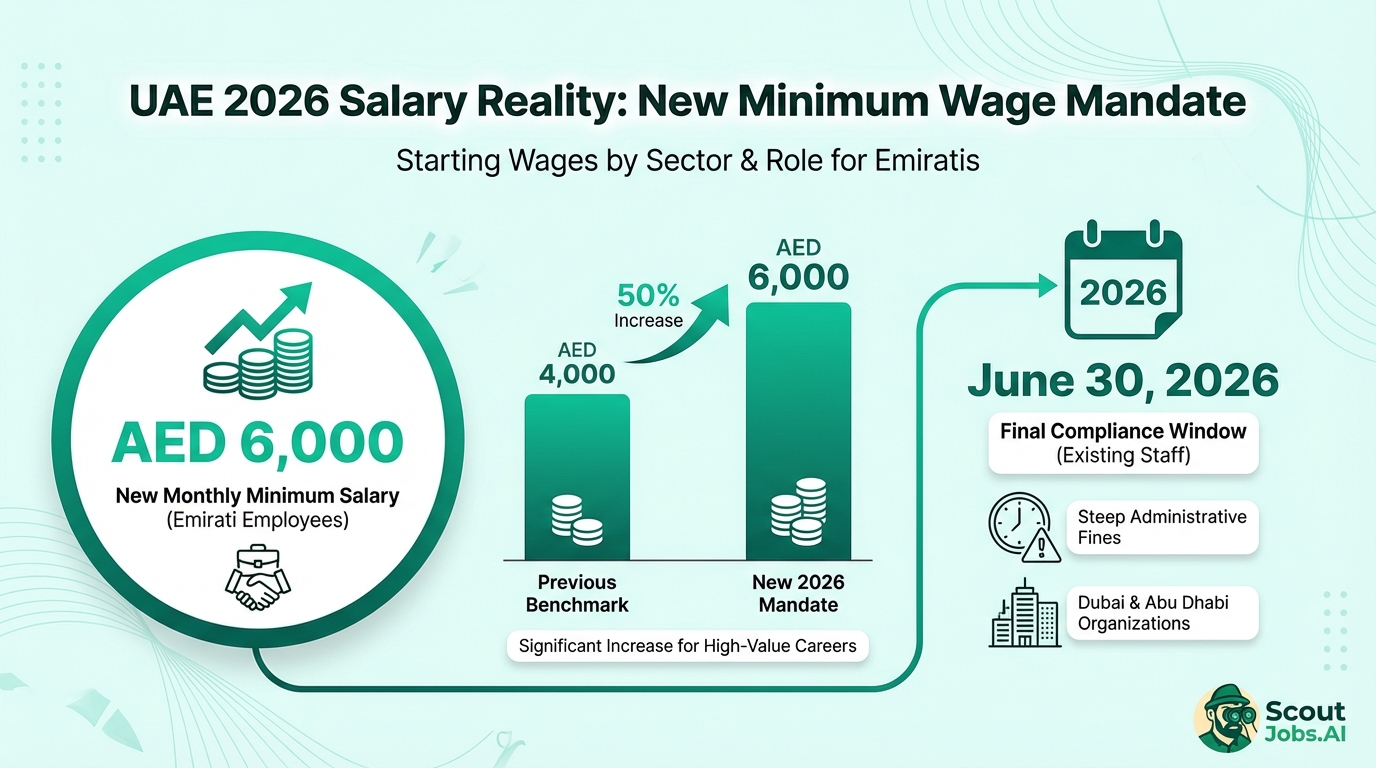
As of January 2026, the Ministry of Human Resources and Emiratisation (MoHRE) has solidified the new regulatory floor for UAE nationals entering the private sector. The landmark mandate now enforces a strict minimum monthly salary of AED 6,000 for all Emirati employees. This represents a significant 50% increase from the previous AED 4,000 benchmark, signaling the government's commitment to ensuring high-value careers within the local workforce.
Compliance Deadlines and Phasing
Employers must act swiftly to avoid penalties. While new hires must receive the AED 6,000 rate immediately, the MoHRE has established a final compliance window for existing staff. By June 30, 2026, all active Emirati contracts must be adjusted to meet this new threshold. Organizations in Dubai and Abu Dhabi that fail to update their payroll systems by this deadline face steep administrative fines and potential blocks on future work permits. This adjustment period allows HR departments to recalibrate their 2026 budgets without immediate disruption to operational liquidity.
Strategic Impact on Nafis and Recruitment
The mandate works in tandem with the Nafis program, which provides additional salary subsidies. For recruiters, this means the 'Starting Wage' is no longer just a recommendation but a legal requirement. Companies are now optimizing their recruitment strategies by focusing on higher-skill roles that justify the AED 6,000 base.
Actionable Compliance Tips:
- Audit Payroll: Review all Emirati contracts before the June 30 deadline.
- Leverage Nafis: Ensure your company is registered on the Nafis portal to maximize available subsidies.
- Skill Alignment: Transition roles toward technical or managerial tracks to maximize the return on higher entry-level wages.
This shift ensures that the UAE remains a competitive hub where local talent is both valued and protected under the latest labor laws.
Tech & AI: The Highest Starting Brackets
The Digital Premium: Why Tech Leads the Market
As we navigate the 2026 economic landscape, the technology sector remains the undisputed champion of entry-level compensation. Currently, ScoutJobs AI tracks over 700 active listings in the IT domain across Dubai and Abu Dhabi, representing the highest volume of high-paying opportunities for new graduates and career-switchers. This demand is driven by the UAE’s 'Digital Twin' initiatives and the massive expansion of the Dubai Internet City ecosystem.
AI Specialists: The New Salary Benchmark
Artificial Intelligence is no longer a future concept; it is the primary engine of the UAE economy. For 2026, entry-level AI Specialists and Machine Learning Engineers are commanding unprecedented starting brackets. Candidates with a strong portfolio in LLM integration or predictive analytics can expect monthly salaries ranging from AED 35,000 to AED 45,000. These figures often include performance-based bonuses and comprehensive relocation packages for international talent. This 'scarcity premium' exists because, while general labor markets have stabilized, the supply of talent capable of building localized AI solutions remains critically low.
Data and Development Foundations
While AI holds the top tier, foundational tech roles also see robust starting wages. Data Analysts entering the workforce in 2026 typically start between AED 18,000 and AED 25,000, while Software Developers specializing in Python, Rust, or Cloud Architecture (AWS/Azure) see offers starting at AED 22,000. Even at the junior level, companies like G42 and various DIFC-based fintech startups are prioritizing technical proficiency over years of experience.
Practical Tips for Tech Job Seekers
To secure these top-tier brackets, candidates should focus on three actionable steps:
- Localize Your Portfolio: Showcase projects that solve UAE-specific challenges, such as logistics optimization for DP World or smart-city applications for DEWA.
- Certify Strategically: Focus on high-value certifications in Cybersecurity (CISM) or Cloud Architecture, which add a 15-20% margin to base offers.
- Leverage ScoutJobs AI: Use our platform’s real-time salary insights to benchmark your offer against live market data in Dubai and Abu Dhabi.
Banking, Finance & HR: Mid-Tier Entry Realities
Banking, Finance & HR: Mid-Tier Entry Realities
While technology commands the highest premiums, the UAE’s financial hubs—specifically the Dubai International Financial Centre (DIFC) and Abu Dhabi Global Market (ADGM)—have established a firm 'market-norm' for 2026. Entry-level compensation in these sectors is increasingly dictated by global benchmarks, ensuring the UAE remains a competitive destination for international talent.
The Standard for Financial Professionals
For Relationship Managers (RMs) entering the banking sector, the standardized starting wage has stabilized at AED 25,000 per month. This figure typically applies to those within retail and commercial banking sectors at institutions like Emirates NBD or FAB. However, there is a distinct divergence based on company structure. Multinational corporations (MNCs) often provide comprehensive benefits including housing allowances and performance bonuses that can increase the total package by 20%. In contrast, boutique investment firms may offer a lower base salary but provide significantly higher commission structures, sometimes exceeding AED 35,000 during peak fiscal quarters. According to Michael Page, financial roles remain a cornerstone of the professional labor market.
Human Resources and Corporate Support
In the realm of Human Resources, entry-level roles such as HR Coordinators and Talent Acquisition Associates have seen a shift toward standardized packages ranging from AED 15,000 to AED 18,000. HR professionals are no longer viewed as purely administrative; rather, they are strategic partners in the UAE’s 'Great Retention' era.
Key Takeaways for 2026 Candidates:
- RM Baseline: Expect a fixed AED 25,000 starting point in major Dubai banks.
- HR Entry: Market norms favor a range of AED 15,000–18,000 for those with SHRM or CIPD certifications.
- Location Impact: Roles based in ADGM or DIFC often carry a 10-15% cost-of-living premium compared to other free zones.
- Growth Rate: Salaries in finance are projected to grow by 4.5% annually through 2027 as digital banking expands.
Engineering & Architecture: Building the Future
Engineering & Architecture: Building the Future
As the UAE accelerates toward its 2040 goals, the engineering and architecture sector has solidified its position as the second most active hiring market in 2026. This surge is primarily fueled by the Dubai Urban Master Plan 2040 and the expansion of sustainable infrastructure projects like Masdar City and the Etihad Rail network, creating a massive influx of roles for junior professionals.
Starting Salary Benchmarks for 2026
For new graduates and junior engineers (0-2 years of experience), the 2026 salary reality reflects a tiered landscape based on specialization. While generalist roles see moderate growth, sectors aligned with the UAE’s green transition command significant premiums.
| Discipline | Monthly Salary Range (AED) | Key Drivers |
|---|---|---|
| Junior Civil Engineer | 6,500 – 10,500 | Urban Master Plan 2040, Metro Expansion |
| Junior Mechanical Engineer | 6,000 – 9,500 | Smart building HVAC, Manufacturing hubs |
| Junior Sustainability/Green Engineer | 8,500 – 12,500 | Net Zero 2050 initiatives, ESG compliance |
| Junior Architect | 7,500 – 11,000 | Luxury residential, Cultural districts |
The Impact of Mega-Projects
Junior talent is no longer just "support staff"; the sheer scale of current mega-projects requires graduates to take on immediate responsibility in BIM (Building Information Modeling) and digital twin technologies. Employers are prioritizing candidates who can navigate high-pressure project cycles, such as the redevelopment of Downtown Dubai and the new Expo 2020 Centre urban hubs.
Expectations vs. Reality
While the demand is high, new graduates often face a reality check regarding "all-in" packages. Many entry-level roles in 2026 now consolidate housing and transport allowances into a single figure, making budget management critical. To secure the upper end of the salary bracket, HR experts at ScoutJobs AI recommend obtaining certifications in LEED, Estidama, or PMP early in the career path to stand out in a competitive, multicultural workforce.
Tourism & Hospitality: Volume Over Premium
Tourism & Hospitality: Volume Over Premium
As we navigate the 2026 landscape, the Tourism and Hospitality sector remains one of the top three hiring engines in the UAE. While other sectors like Engineering offer higher liquid cash, Hospitality thrives on a 'volume over premium' recruitment model. For entry-level professionals—ranging from front-of-house staff to junior coordinators at major hotel groups like Jumeirah or Emaar Hospitality—starting wages typically begin around AED 10,000 per month. While this may seem lower than the tech or finance sectors, it is vital to evaluate the total compensation package.
The Value of Total Compensation
In Dubai and Abu Dhabi, the 'cash component' is often only 60% of the actual value provided to employees. Most hospitality roles include comprehensive non-cash benefits that significantly lower a professional's cost of living. These typically include:
- Company-provided accommodation in dedicated staff complexes.
- Daily transport to and from the workplace.
- Duty meals and full medical insurance.
- Service charge distributions and performance-based tips.
When these factors are monetized, a starting salary of AED 10,000 effectively functions like a AED 16,000 salary in other sectors where the employee must pay market-rate rent in areas like Dubai Marina or Business Bay.
High-Demand Skills for 2026
To move quickly into the premium wage brackets, candidates must master specific technical and soft skills. There is a massive demand for professionals proficient in Customer Relationship Management (CRM) systems and personalized guest data analytics. As the UAE pivots toward hyper-personalized tourism experiences, the ability to manage digital guest journeys is highly rewarded. Furthermore, exceptional multi-lingual customer service remains a gold standard. HR experts note that candidates who demonstrate high emotional intelligence (EQ) and fluency in emerging tourism markets—such as Mandarin or Russian—frequently see faster promotion cycles, moving into mid-management within just 18 to 24 months.
The 'Lifestyle Dividend' and Negotiation Shifts
In the 2026 landscape, the power dynamic in UAE boardrooms has undergone a fundamental shift. While the post-pandemic era was defined by the luxury of "work-from-anywhere," the current reality is driven by cold, hard cash. According to recent market data from Charterhouse, 66% of professionals in the UAE now prioritize higher base salaries over remote work flexibility. This pivot is largely fueled by the rising cost of living in prime districts like Dubai Marina and Downtown Abu Dhabi, where rental yields and school fees have outpaced traditional 3-5% annual increments.
The Return of Employer Leverage
The UAE’s population surge—accelerated by the expanded 10-year Golden Visa and 5-year Green Visa categories—has created a massive surplus of global talent. In 2026, employer power has firmly returned. With thousands of qualified professionals arriving monthly from London, Mumbai, and Singapore, companies no longer feel the urgency to offer astronomical "hardship" packages. Instead, we are seeing the final decline of the "legacy expat package" that once included separate, generous housing and education allowances paid directly to providers. Today, major firms like Majid Al Futtaim or ADNOC favor localized salary benchmarks, providing an all-inclusive monthly sum that requires employees to manage their own lifestyle costs independently.
Calculating the 'Lifestyle Dividend'
Despite the consolidation of packages, the UAE remains a premier global destination due to the "Lifestyle Dividend." Candidates frequently accept a 10-15% lower base pay compared to high-tax jurisdictions like Paris or New York. This calculated trade-off accounts for the world-class safety—with the UAE consistently ranking in the top three safest countries globally—seamless infrastructure, and the 0% personal income tax.
Professional Negotiation Strategies
- Utilize Local Benchmarks: Use ScoutJobs AI tools to reference current AED rates for your specific sector before the interview.
- Focus on Total Cash: Negotiate for a higher all-in monthly figure rather than seeking archaic separate allowances.
- Quantify Your UAE Network: Highlighting your local "know-how" and existing vendor relationships can justify a premium over international candidates.
Salary Stability: Why 25% of Firms Aren't Budging
The 25% Holding Pattern: Why Some Salaries Are Stagnating
While market headlines often highlight record-breaking increments, a significant 25% of UAE organizations are planning zero base-salary adjustments for 2026. This trend marks a shift toward "long-term normalization." After years of aggressive post-pandemic hiring, many firms in the private sector—particularly in traditional retail and non-specialized services—are reaching a ceiling on fixed costs. Instead of increasing monthly pay, these employers are leaning into performance-based bonuses to manage risk while maintaining stability. Data from Cooper Fitch confirms that the focus has transitioned toward retention through incentives rather than fixed salary increases.
The 'Deep Talent Pool' Leverage
One primary driver for this caution is the sheer volume of global talent moving to the Emirates. With Dubai’s population recently surpassing 4 million, the competition for non-technical roles has intensified. Recruiters report that generalist job postings often attract over 2,000 applicants, effectively creating a "buyer’s market." Consequently, firms no longer feel the same pressure to overpay to secure entry-level or operational talent. In some sectors, organizations are even recalibrating starting salaries for new-to-market candidates, which are roughly 10-15% lower than those offered to candidates with local GCC experience.
Managing the Internal Equity Tightrope
HR departments are currently navigating a delicate balance between external hiring costs and internal equity. Offering inflated salaries to new joiners can trigger dissatisfaction among existing employees, leading to higher turnover. To mitigate this, expert consultants recommend:
- Prioritizing Retention: Using performance-linked incentives rather than fixed hikes.
- Transparency: Communicating the total reward package, including visa and insurance benefits.
- Skill-Based Pay: Reserving budget for high-impact specialist roles in AI and cybersecurity.
| Professional Segment | Salary Adjustment Outlook 2026 | Priority Strategy |
|---|---|---|
| Specialized Tech/AI | 8-15% Increase | Talent Acquisition |
| Mid-Level Finance/HR | 3-5% Increase | Employee Retention |
| General Services/Retail | 0% (Stagnant) | Cost Optimization |
Economic factors, including the new 9% corporate tax and mandatory Emiratisation minimum wages (now AED 6,000 for private-sector nationals), are further compelling firms to be more strategic and conservative with their annual payroll budgets.
Key Takeaways for 2026 Job Seekers
Navigating the 2026 Salary Landscape
As we move through 2026, the UAE job market presents a bifurcated reality. While the wage floor for entry-level administrative roles in Dubai remains stable around AED 8,000–12,000, specialized tech sectors are seeing ceilings shatter, with AI engineering roles commanding upwards of AED 45,000 monthly. To maximize your earning potential in this high-competition environment, you must transcend basic job descriptions.
The Upskilling Premium
Data from ScoutJobs AI indicates that candidates possessing verified competencies in Generative AI and Data Analytics earn 15–20% more than their peers in the same bracket. Whether you are in marketing or finance, integrating AI tools into your workflow is no longer optional; it is your primary leverage for hitting higher starting brackets. In Abu Dhabi and Dubai, HR departments are increasingly prioritizing 'future-proof' talent over traditional experience.
Negotiating Beyond the Dirham
With 25% of firms holding base salaries steady, savvy seekers are pivoting their negotiation strategies. If a firm hits its cash limit, focus on 'Lifestyle' benefits which can offer equivalent value. Demand flexible remote-work days to save on commuting from Sharjah or ask for comprehensive family health insurance and annual flight allowances (averaging AED 5,000–8,000 in value).
Strategic Market Positioning
In a high-population market, your value is defined by specialization. Focus on niche sectors like Green Energy or Fintech, where talent shortages persist. By aligning your skills with the UAE’s strategic 2026 economic goals, you transform from a replaceable applicant into a high-value strategic asset.
Conclusion: Navigating the New Normal
Navigating the New Normal
As we conclude our analysis of the 2026 UAE salary landscape, it is evident that the market has reached a state of sophisticated maturation. No longer defined solely by tax-free allure, the Emirates now prioritizes value-based compensation. The impact of the Ministry of Human Resources and Emiratisation (MoHRE) remains profound; their continued focus on wage transparency and the Wage Protection System (WPS) has created a more predictable, secure ecosystem for both expatriates and UAE nationals.
Leveraging Real-Time Data
In this evolving environment, static salary guides quickly become obsolete. To stay ahead, job seekers must utilize dynamic platforms like ScoutJobs AI for real-time benchmarking. Current data indicates that 65% of successful candidates in Dubai’s DIFC and Abu Dhabi’s Global Market now negotiate based on live market analytics rather than historical averages. By monitoring active listings, you can identify exactly when demand in sectors like Green Tech or FinTech triggers a shift in entry-level expectations.
Your Strategic Next Step
The most effective way to validate these sector-specific wages is to engage directly with the current market. We encourage you to review our latest job listings on ScoutJobs AI today. Use these insights to calibrate your expectations and approach your next interview with the confidence that only verified data can provide. The future of UAE employment is data-driven; ensure your strategy is too.
Frequently Asked Questions About UAE Salaries
Frequently Asked Questions About UAE Salaries
Navigating the nuances of compensation in the UAE requires a deep understanding of local regulations and evolving market trends. Here are the most pressing questions job seekers are asking in 2026.
Does the AED 6,000 minimum wage apply to expats?
It is a common misconception that the UAE has a universal minimum wage for all residents. As of 2026, the Ministry of Human Resources and Emiratisation (MoHRE) primarily mandates minimum salary thresholds for UAE Nationals under the Nafis program to ensure sustainable private-sector employment. For expatriates, there is no legally fixed national minimum wage; instead, salaries are determined by the contract signed between the employer and employee. However, MoHRE ensures that wages are 'sufficient to meet basic needs' and monitors this through the Wage Protection System (WPS). If a professional role is offered significantly below market standards, it may face scrutiny during the visa approval process.
Which city offers higher starting wages: Dubai or Abu Dhabi?
The answer depends heavily on your industry. Abu Dhabi typically offers higher starting packages in the energy, defense, and government-linked sectors, often 5–10% higher to account for specialized technical requirements. Conversely, Dubai remains the leader for higher starting wages in technology, tourism, and creative industries. In 2026, the gap has narrowed as remote work allows professionals to live in the Northern Emirates while earning Dubai-level salaries, though Abu Dhabi’s public sector roles remain the most lucrative for administrative and engineering positions.
Are housing allowances still paid separately in 2026?
We are seeing a definitive shift toward 'all-in' consolidated salary packages. While the traditional breakdown of Basic Salary (60%) and Allowances (40% for housing/transport) still exists for gratuity calculation purposes, many modern firms in Dubai Internet City and ADGM now offer a single monthly lump sum. This gives employees more flexibility in managing their cash flow, though it is crucial to check your 'Basic Salary' figure, as this remains the legal basis for your end-of-service benefits.
What are the most in-demand skills for 2026?
To command a premium starting wage, candidates must demonstrate proficiency in AI-integrated workflows. High-demand roles currently focus on:
- CRM Strategy: Managing complex customer lifecycles in real estate and retail.
- AI Implementation: Moving beyond prompt engineering to actual workflow automation.
- Specialized Sales: Relationship-based selling in the B2B SaaS space.
How often should I expect a salary review?
In the UAE private sector, annual performance reviews are the standard. However, due to the high cost of living adjustments in 2026, many top-tier firms have moved toward bi-annual 'pulse checks' to ensure talent retention. A typical annual increase ranges between 3% and 7%, depending on individual KPIs and company profitability.
Is the tax-free status expected to change in 2026?
There is no personal income tax in the UAE for 2026. While Corporate Tax is firmly established, the government remains committed to maintaining a tax-free environment for individuals to attract global talent. This continues to make the UAE one of the most competitive destinations for wealth accumulation globally.
Written by
Mohammed Sohail